Tuesday, February 19, 2008

Questions of framing our projects

Right now I am developing a project that will use an enlarger used in printing photos.  I plan to use three dimensional objects to project images on photopaper.  

My question about frame is as follows: do the limitations of the edges of the photopaper create a natural frame for my project or can I somehow break free from this inherent frame and the limitations that arise from it?

The nature of this project, the use of photopaper, results in a natural frame already existing: the edges of the paper.  I hope to break this inherent frame by using multiple pages connected together, possibly into 3D.

Concerning Brandon's Project:

Brandon is attempting to explore the nature of emotions and the variability that exists in the manner in which individuals express their emotions.  We discussed the fact that a natural from the exists for emotions is the human body.  Therefore, how might he frame, this natural frame to develop an expression of this variance?  Should the frame of a photographic lens be used?

It was suggested that he shoot different parts of the human body at different magnifications in an attempt to see if people can identify the emotion being displayed with minimal input.

Tuesday, January 22, 2008

Responses From Class 1/22/08 and 1/15/08

Some ideas that I have come up with for the project thus far:

  • placing a microphone in a couple locations throughout my apartment and having it turn on a different times throughout the week and record the activity. At the end of the week create a compilation of what has occurred in that space through incorporation with music.
  • varying the frame rate of a slideshow like projection to get merging images
  • building filters for my camera and attempting to shot things that fit the filters. For example building a lens cover that has a word cut out of it and then shooting something that portrays this word so that you get only portions of the image that fall in the cut-out letters. This could be done with figures as well.

____________________________________________________________________
Response From Class 1/15/08

Yannis Ritsos - Erotica XII
I feel that the use of the present tense in this piece allows you to visualize what is going on much easier. With the present tense you can see the actions that are tacking place as they are happening. With the past tense you don't have such an opportunity, it is much more natural to hear and feel what is actually going on in the following section of the poem:

A hoop from a barrel of olden times rolls down the hill,
falls into the stream, tossing off drops that wet your feet,
and also wet your chin. Stop that I may wipe you.

The use of present tense puts you right in the action, right where it is taking place. You can see the hoop rolling and throwing drops of water; you can feel them on your feet.

Ernst Jandi - Preliminary Studies for the Frankfurt Readings 1984
The following are a couple links that show videos that explore the mouth as a servant. These are extreme cases in which people have harnessed the control of the mouth to a level many are not capable of.

This guy can speak the words in sentences completely backwards:


The fastest speaking person in the world (go to minute 1:00 of the video):


The fastest drinker:


Octavio Paz - Blanco

I think that the structure of this passage allows for some personal interpretation on how it should be read. This is especially present in the sections of the piece that are composed of two components side-by-side, each containing different fonts. One of them is bold, the other is italicized. Should you read the bold component first, then read the italicized component, or should you read one line of the bold, then the corresponding line in the italicized. I read the passage once each way. Even though on first glance it may seam unnatural to read one bold line followed by one italicized line (because they appear to have been intentionally separated), I actually like to see the similarities and differences between each individual line. Reading directly across the page helped identify these.

1.22.08 - Thoughts on Space

This discussion on how the boundaries of an entity, whether it be something as simple as a blog, or as complicated as the universe is interesting. It is simple to write off the boundaries as uninteresting void space. The space of text is limited by the margins, but rather than viewing the margin as void, they can be viewed as an intrinsic portion of what the piece of work is. They can be utilized to give structure.

How do things exist in space?
My experience in math and engineering causes a natural reaction to refer to the three dimensional Cartesian Coordinates that I have been using for years in class. This system consists of three axes with incremental markings of distance along each side.

definition of axis: ax·is
1. A straight line about which a body or geometric object rotates or may be conceived to rotate.
2. Mathematics
a. An unlimited line, half-line, or line segment serving to orient a space or a geometric object, especially a line about which the object is symmetric.
b. A reference line from which distances or angles are measured in a coordinate system.

These axes are labeled (x,y,z) in the Cartisean system. The figure below shows this system.


Any position in space can be explicitly described by providing the three values of x, y, and z. For something to exist in space it must have these three values that define where it is. If the object occupies a volume, this volume can be defined as an accumulation of all the points within its volume.
____________________________________________________________________
Response to Second Series from 3 x 11 Tristychs:

This piece is hard for me to wrap my head around. After reading the commentary after the piece I understand that this Second Series is a series of separate poems each numbered and collected as a unit. Does each numbered piece stand alone, or does Yannis Ritsos have an overall theme? How does the space between these separate poems affect how one reads this series?
From Thylias' comments on her Blog, I can assume that the original work was very different than this re-printing in the Anthology. I would imagine that the arrangement of the short poems would have been more dramatic. Did this arrangement help define a uniting theme with the poems?

____________________________________________________________________

Drawing Blue Song Candidates From Super Vision


I currently do not own Super Vision. I need to re-examine the book in class one day to identify a couple candidates.

I searched for some images that are similar to those found in Super Vision, and have found some that could be applied to the blue song:

Cell nuclei of the mouse colon (740x) by Dr. Paul Appleton. Taken from Nikon's Small World competition for the best microscopic image:
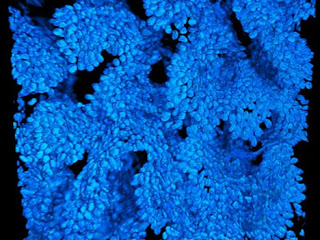

"Nikon's Small World winning image emerges from blackness to reveal the delicate, blue pebbly texture of the cell nuclei of a mouse colon as seen through the microscope. This winning image is the work of Dr. Paul Appleton, a researcher from the Division of Cell and Developmental Biology at the University of Dundee in the UK." (Quote Taken from www.medgadget.com/archives/img/76575mou.jpg)

Another Image from Nikon's Small World Competition
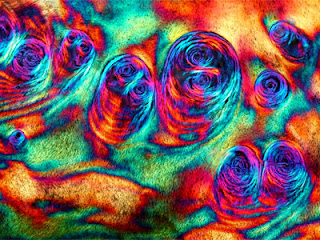


Here's the link to the page for this competitions. It's actually really amazing stuff!

http://www.nikonsmallworld.com/