This discussion on how the boundaries of an entity, whether it be something as simple as a blog, or as complicated as the universe is interesting. It is simple to write off the boundaries as uninteresting void space. The space of text is limited by the margins, but rather than viewing the margin as void, they can be viewed as an intrinsic portion of what the piece of work is. They can be utilized to give structure.
How do things exist in space?My experience in math and engineering causes a natural reaction to refer to the three dimensional Cartesian Coordinates that I have been using for years in class. This system consists of three axes with incremental markings of distance along each side.
definition of axis:
ax·is
1. A straight line about which a body or geometric object rotates or may be conceived to rotate.
2. Mathematics a. An unlimited line, half-line, or line segment serving to orient a space or a geometric object, especially a line about which the object is symmetric.
b. A reference line from which distances or angles are measured in a coordinate system.
These axes are labeled (x,y,z) in the Cartisean system. The figure below shows this system.

Any position in space can be explicitly described by providing the three values of x, y, and z. For something to exist in space it must have these three values that define where it is. If the object occupies a volume, this volume can be defined as an accumulation of all the points within its volume.
____________________________________________________________________Response to Second Series from 3 x 11 Tristychs:
This piece is hard for me to wrap my head around. After reading the commentary after the piece I understand that this Second Series is a series of separate poems each numbered and collected as a unit. Does each numbered piece stand alone, or does Yannis Ritsos have an overall theme? How does the space between these separate poems affect how one reads this series?
From Thylias' comments on her Blog, I can assume that the original work was very different than this re-printing in the Anthology. I would imagine that the arrangement of the short poems would have been more dramatic. Did this arrangement help define a uniting theme with the poems?
____________________________________________________________________
Drawing Blue Song Candidates From Super Vision
I currently do not own Super Vision. I need to re-examine the book in class one day to identify a couple candidates.
I searched for some images that are similar to those found in Super Vision, and have found some that could be applied to the blue song:
Cell nuclei of the mouse colon (740x) by Dr. Paul Appleton. Taken from Nikon's Small World competition for the best microscopic image:
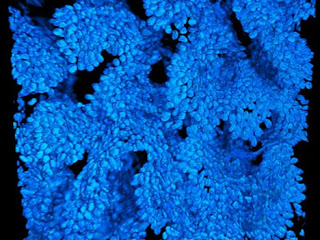
"Nikon's Small World winning image emerges from blackness to reveal the delicate, blue pebbly texture of the cell nuclei of a mouse colon as seen through the microscope. This winning image is the work of Dr. Paul Appleton, a researcher from the Division of Cell and Developmental Biology at the University of Dundee in the UK."
(Quote Taken from www.medgadget.com/archives/img/76575mou.jpg)
Another Image from Nikon's Small World Competition
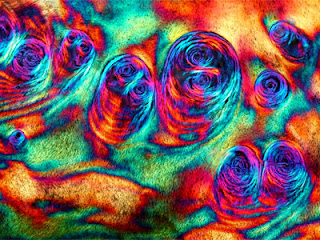
Here's the link to the page for this competitions. It's actually really amazing stuff!
http://www.nikonsmallworld.com/


 This next one was created by merging a picture of a car from the Detroit autoshow with picture of tree bark. I liked the juxtaposition of this image

 I plan to shoot things that change within a relatively short amount of time and superimpose the images upon one another. Some ideas that I have right now are the following: a melting ice cube, a wilting flower, blooming tree....I'm still thinking of others.